
She has been at the top of Allianz Benelux for over a year and feels completely at home in the world of insurance. CEO Claudia Max knows what hard work is. She spent her childhood in Germany and learned that there is no 'free lunch' in life. "My parents have always encouraged me to do what I like, but nothing has come naturally to me."
Max is known as a multi-talent. Because of her previous work at McKinsey, she can switch gears at lightning speed. One of her first consulting projects was for an insurance company. Very coincidentally at Allianz. That job opened her eyes. "I was positively surprised and immediately found the work fun and concrete. I've never done anything in another industry again, but let's face it, the insurance industry isn't seen as sexy. Nobody says on their own: nice, I'm going to work for an insurer later. A shame, because it is a fascinating and interactive world. With relatively simple means, we can really help people. I love my job. And I like to get better every day, so the insurance sector fits me like a glove."
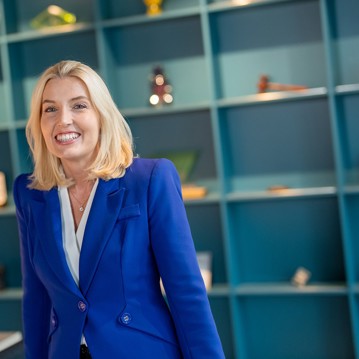 Claudia Max has been Regional CEO of Allianz Benelux since 1 January 2025 . Prior to that, she worked at the Zurich Group, first as Managing Director for all overarching sales activities for Zurich Germany and later as a member of the German Board of Management and Chief Underwriting Officer.
Max started her career at McKinsey, where she was a member of the European Insurance and Asset Management leadership team.
She obtained her master's degree in Law and Accounting from the London School of Economics and Political Science and a PhD from the Technical University of Darmstadt.
Claudia Max has been a member of the board of the Dutch Association of Insurers since the General Meeting of Members in December 2025.
Curious about our previous portraits in the context of International Women's Day? Read the stories of Ingrid Visscher, Babs Dijkshoorn and Femke Bakker.
March 8 is International Women's Day. Max sees that day as a good opportunity to take stock. But also as a day to make progress in creating equal opportunities. "I see Allianz as a pioneer in many ways. For example, in our international Board of Directors, four of the nine members are women, all with very large, international responsibilities. There is no symbolic policy with us. But despite this progress, we should not be naïve. Prejudices still exist in the world around us. I think that, as CEO, I have to be alert to that and make sure that we continue to make progress."
She herself prefers to look at diversity with a broad view. "It should not only be about men against women. Although it would be good if men became women's greatest ambassadors." She laughs. "Do you know what often works well? If you talk to male leaders about their daughters." She thinks for a moment and then asks: "How many women have you actually interviewed about the topic of equality and International Women's Day? Maybe you should interview a man next year. Diversity only works if the men also go along with it. They have to take their share in the household and in the upbringing of children. Just as women have supported men, men can now support women."
She brings it with a wink and emphasises that there will always be differences between men and women. "But also between you and me. That's why I prefer to look at diversity more broadly. We all know that diverse teams perform better. And yet we are often guided by (unconscious) prejudices. In fact, we usually promote the people who are like us. We have to work on that. We have to judge people on their performance. Not on their gender, background, ethnicity or race. Gender is perhaps the most visible, but your origin and the culture in which you were raised are also important."

The board at Allianz Benelux is doing well with diversity, she thinks. "We are with five people, so 50-50 will be difficult. We now have two women and three men on the board, but as far as I'm concerned, it's not just about men and women. We are five people from five different countries, all with different backgrounds. This sometimes leads to great discussions and it fits in well with the Allianz culture. We believe that diverse teams add more value. In homogeneous teams, you may agree with each other more quickly, but diversity allows you to come up with better solutions and decisions."
She gives an example. "We think it is important that promotions are fair. We therefore work with several assessors, provide clear criteria and external assessments for the higher positions, so that the selection process is as unbiased as possible."
She comes back to it a few times: she thinks fair trials are perhaps even more important than, for example, a female talent program. "Suppose we are looking for a successor, then there is explicit attention to the diversity criteria. If there are only men in the succession pipeline, then that pipeline will not turn green, because it is not diverse enough. And of course we have all kinds of programs that focus specifically on women, young people or parents, but I think those hardwired topics such as fair trials are extremely important."
The diversity in the board also fits in nicely with the still relatively new Benelux set-up that Allianz is striving for. "The name says it all. Allianz BeNeLux is located in Belgium, the Netherlands and Luxembourg. We have been Benelux since 2012, but recently we no longer have local CEOs. The five of us form one board for the three countries."
Does she see many differences between the Netherlands, Belgium and Luxembourg? "As a German, I try to be neutral," she replies with a laugh. "Of course there are many differences, but also plenty of similarities. We are one team and share best practices. We should not focus too much on the differences, but rather use the benefits of synergy."
She has only been in the chair as CEO for over a year, but is enjoying it immensely. "I think it's very positive how our people are dealing with the strategy. They believe in it, contribute to that strategy and are involved. We have many people who have been employed for a long time. They have really taken the company to their hearts. Nice to see."
She does not want to call it family, but emphasises that there is a lot of talk about the human touch at Allianz. "Insurance is analytical and we work a lot internationally. But insurance is also about trust and cooperation. A family feeling is difficult to explain. Everyone has to experience that for themselves. We think human contact is very important. That is why we not only organise Christmas activities and other fun things for our employees, but we are also busy with charities and support para-athletes in their ambitions. It's not just about making a profit, you also have to give something back to society. Our group CEO Oliver Bäte now often emphasises how important it is for the insurance industry to use the "profits" that AI offers to keep insurance affordable. I'm really proud to work for a company that has that drive and strives for a higher purpose."

Allianz is a large company, with more than 97 million customers in almost seventy countries. It employs more than 156,000 people worldwide. "In daily life, I constantly notice how big we are. I see our logo everywhere, even at the Winter Olympics. But at the same time, it surprised me how easily I can make contact. I can always approach and reach colleagues in other countries. The lines are short. We connect countries and functions, which makes us large, but also accessible."
Last year, Allianz Benelux won the Great Place to Work award. Max thinks it's a great certification, especially because it is direct feedback from employees. "We often ask for that feedback ourselves, about three times a year, to keep improving ourselves. We participated in that Great Place to Work for the first time and no less than seventy percent of the employees said that Allianz is a great place to work. As far as I'm concerned, we'll participate again next year, because this tastes like more."
She describes her own leadership style as direct and ambitious, but also honest. "I say what I like and what I don't." That wink again. "I regularly visit Rotterdam and I have embraced the what you see is what you get principle. I also have to make difficult decisions and realise that I have been appointed as CEO, not elected. Every decision must be fair."
In addition, she strives for less hierarchy and more support. "I consciously look for feedback, even when it comes to practical matters such as noise in the workplace or lunch in the canteen. I am in favour of a new form of leadership, in which we coach our employees more than we assess them and help them to get the best out of themselves."
Max works hard and has inherited that from home. She grew up with her brother in a small town in southern Germany. "My parents supported me, but nothing was free. As a teenager I worked during the holidays to earn money and to be able to go on holiday. I learned at a young age that there is no free lunch ."
Her mother was a nurse and her father worked in technology. "I had a wonderful childhood and always felt free to do what I wanted."

She doesn't really have a role model, but if she has to name one, it's her mother. "I learned humility from her. Keep both feet on the ground and don't take yourself too seriously. Regardless of your status, you just remain a human being and you have to behave well."
She emphatically inherited that integrity and authenticity from her parents. "Important, especially if you have to lead a company. My parents always encouraged me to do what I liked. I'm happy about that, because you only perform well if you enjoy what you do. I love my job and don't have big dreams or a full bucket list. Like everyone else, I just want to be happy in my daily life."
When asked if she is a born leader, she shakes her head. "What is a born leader? Is it in your genes? Can you have a talent for that? I have always loved organising and was often the captain of the sports team. I get energy from that and see it mainly as a starting point, because you never stop learning."
As far as Max is concerned, the secret is in a good balance. "I eat well, don't drink wine during the week, get enough sleep and exercise three times a week. I need that discipline and routine to be able to function properly. In Germany, we always say: what you can do today, you shouldn't put off until tomorrow. I do crossfit and to be honest, I never feel like it beforehand, but afterwards I feel great. That's also what I tell myself. Not only in sports, but in my whole life: just do it!"
(Text Ellen Jonges & Miranda de Groene - Image Ivar Pel)