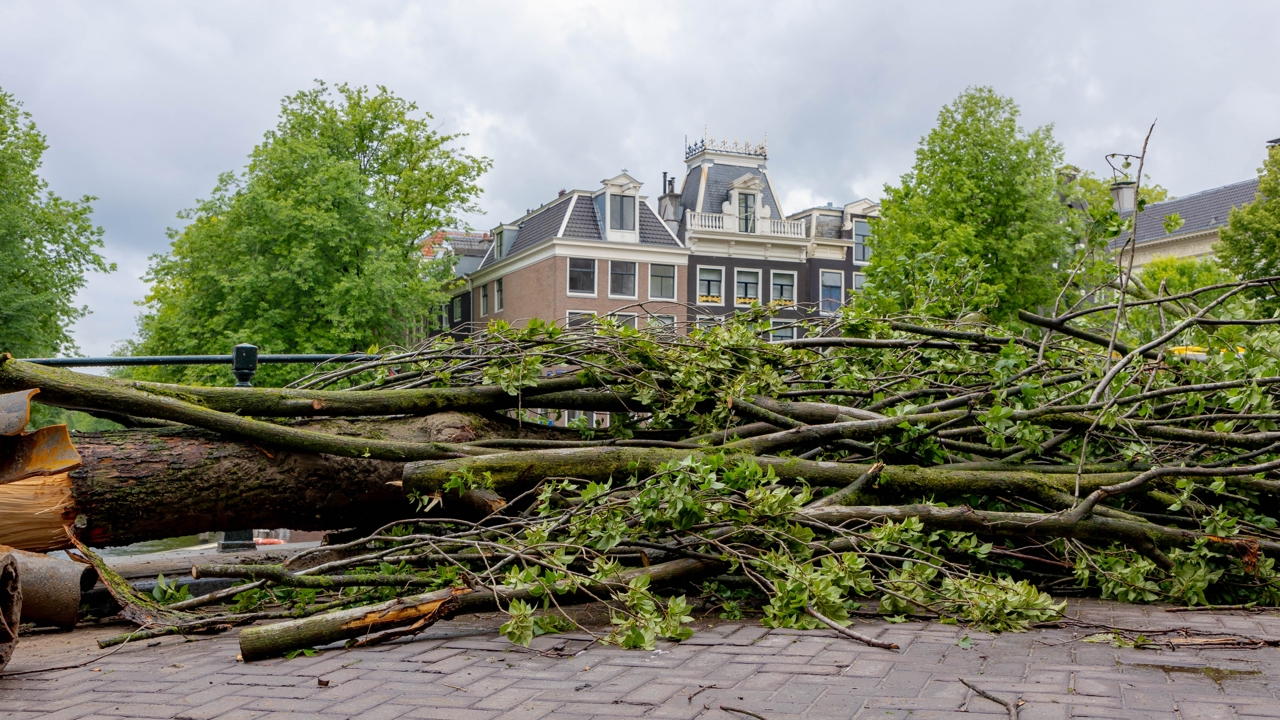
Insurers are seriously concerned about climate damage due to rising sea levels, an increase in drought and more extreme rainfall. This leads to more floods or long periods of drought. Both weather extremes lead to private and business damage to homes, business premises and cars. But also to damage to crops, damage due to business interruption and damage to government property, which are generally not insured.
On this page we tell you about our positions and actions to prevent damage caused by flooding and drought and what insurers do if damage does occur.
The low groundwater level, partly due to climate change, threatens the foundations of approximately 1 million homes and other buildings in large parts of the Netherlands. This causes damage to wooden and shallow foundations.
> Visit our page about Foundation Problems
As far as subsidence is concerned, the risk is so certain and large that insurance is not a solution: it is a billion-dollar risk for homeowners and their mortgage lenders. In addition to climate change, groundwater level management and foundation types play a role. That is why national direction is needed, which insurers are arguing for together with a broad coalition.
It is getting warmer and drier in the Netherlands. This is evident from various Climate Scenarios of the KNMI. The weather is becoming more extreme. You can see the consequences of this in our Climate Damage Monitor, in which we keep track of the insured damage caused by extreme weather. Due to climate change, wildfires are becoming more common in our country, and they also have more impact. Keeping these types of risks manageable must be a collaboration between insurers, government and science.
In the adviesrapport Overstromingen (2018) the Association advises its members to also provide cover for local flooding in the building and contents policy. It differs per insurer whether - and how - they have translated this advice into their own terms and conditions.
Almost all insurers cover damage to homes and streams overflowing due to extreme rainfall and, more recently, the collapse of secondary flood defences ('local flooding'). Damage due to, for example, the failure of facilities, such as electricity, is also generally covered by the policy conditions.
It is a bit different with business damage. The above causes of damage are now also insured on most business policies, but insurance for entrepreneurs is often tailor-made, with the help of a financial adviser. Some companies and institutions have insured themselves through a so-called 'stock exchange policy'. With the additional model clause of the VNAB , the stock exchange policy can easily be expanded to include flooding of so-called secondary flood defences: small rivers and streams, the local flood risk. This means that insurers and advisers have taken another important step in further insuring flood risks in the Netherlands. We advise entrepreneurs to contact their own adviser/insurance broker. Adfiz has set up a knowledge portal for financial advisers.
The situation is different with flooding from large rivers such as the Meuse, large inland waters such as the IJsselmeer, or from the sea. Fortunately, we have very good dykes. But if things go wrong, the damage can be so great that insurers cannot bear the risk. Moreover, there is insufficient demand for insurance for larger rivers and the sea. This is due to low risk awareness among people and because not everyone is at the same risk of flooding. But also because of the existence of the 'free' government compensation through the Disaster Damage Compensation Act (Wts).
It is estimated that 99% of households and businesses are not insured for flooding of the sea and major rivers. While insurance actually contributes to faster recovery and less consequential damage. The Association is discussing this with the government and other relevant organisations.
The Association presented three options to various ministries in mid-2023. In the letter to parliament published in June 2024, the outgoing cabinet indicated that it would like to further explore the one-stop shop direction with insurers. With this solution, the insurer is the first point of contact for the consumer. The experienced employees of the (non-life) insurer settle the flood damage from a single counter, according to fixed working agreements and in a way that is understandable to a citizen. The results of this exploration are expected to be available in the first quarter of 2025.
After flooding, the water must be pumped out and the mess cleaned up. There is a lot to consider when tidying up, cleaning and drying after water damage. We warn of dangerous situations:
Protection – Do not walk through the water if the electricity has not yet been turned off or the water may be heavily contaminated.
Drying process - The drying process takes a long time. Forced and accelerated drying can lead to more damage to the home than a gradual and natural drying process.
Drying time – Remove wet carpets and carpeting, this promotes the drying time of the building and its contents.
Ventilation – Open windows and doors so that the room is ventilated as much as possible.
Back pressure - When pumping out rooms such as basements, basements and living rooms, take into account back pressure from water in adjacent rooms. Allow the water to drop evenly to avoid uneven pressure on walls.
Electricity – Water and electricity is a dangerous combination. Do not test electrical equipment yourself. Have this assessed by an electrician. This prevents the risk of short circuits and fire. And is or was there water in the meter cupboard? Have it checked first.
Vehicles - Do you have a vehicle that has been in the water for a long time? Then don't start it right away.
In the brochure Eerste hulp voor particulieren you can read how the Salvage Foundation helps victims and what you can do yourself after damage.
The total insured damage due to the severe weather in Limburg and North Brabantin the summer of 2021 amounted to 211 million euros, most of which in South Limburg, according to the insurance industry's annual financial report.
In total, insurers received approximately 25,000 claims in 2021 as a result of the flooding in July, the majority of which (10,000 claims) in South Limburg. The majority of the claims concerned private damage to homes and vehicles. A smaller proportion concerned business damage to commercial buildings and vehicles. In addition to material damage, there was damage to crops and business interruption. Finally, there was a lot of damage to government property, which is usually not insured.
Insurers did everything they could to settle the insured claims quickly, but ran into complex water damage whose drying time took months. Very annoying for victims who wanted to return home as soon as possible or to make a restart with their business.
The municipality, the fire brigade, defence and local residents immediately came to the rescue. Insurers also took action through the deployment of Salvage coordinators, claims handlers, loss adjusters and cleaning specialists. How did the claims settlement get started and how do these professionals work together to assist customers in need? The Association discussed this with Stichting Salvage, a.s.r. and Polygon Nederland.