
Tabarki is the founder of Studio Zeitgeist. He does not call himself a trend watcher, but a zeitgeist researcher. He has boundless energy and is constantly on the move. This time he celebrated New Year's Eve in Pakistan, the 191st country he visits in his life. Before he turns 50, he wants to have visited all 200 countries of the world. With a reason, because he prefers to investigate the zeitgeist with his own eyes. "When I sit at my desk in Amsterdam, I see everything through a filter. I read an article through the eyes of a journalist and I see a documentary through the eyes of a documentary maker. I want to observe for myself."
How do you look back on the past year?
"I thought it was a year to forget quickly, although of course good things have also happened. 2025 has proven to me that technological developments follow each other faster and faster. Everyone has pretty much discovered and worked with AI, but now we are running into challenges. Among other things, in the field of privacy. Can ChatGPT be trusted? How are we going to integrate it into our business? New competencies are required of people and that is why we must ensure that they can also deal with them. Those who cannot keep up run the risk of losing their job. That's new and so we get used to it."
Also for insurers?
"Especially for insurers. We see more and more often, especially among young people, that people can no longer keep up because of this enormous acceleration. They have to deal with health problems, including burnouts. This means that substantial investments must be made so that people can keep up and their health is maintained."
How do you do that? Investing in attention? Training? Or in confidence?
"My big plea is always lifelong development. Both the government and the business community have an important responsibility to encourage the working population to work on themselves. We have to invest heavily in keeping up. Especially self-employed people who want or have to declare every hour do not always take good care of themselves and are vulnerable. So we have to come up with smart things together to offer self-employed people the space and opportunities for long-term employability in the labour market. In addition, we also need to pay more attention to teamwork. Maybe that one colleague in your team can teach you more about technological gadgets, because he is just a little more handy at it. If you give people responsibility, they usually take it."
What kind of year will 2026 be? Are we going to work together more and develop ourselves better?
"I hope so. By the way, I don't predict so much per year, but I look more at the longer term. In recent years, we have realised that technology is not only advancing, but also affecting us all. In the coming years, organisations will therefore have to think carefully about what this technology means for them. How can they work with AI in a safe way? This year, the use of AI will increase sharply and the cat-out-of-the-tree viewers will also be won over. And if everyone goes on a journey of discovery, there is a good chance that all kinds of new applications will arise. For example, insurers are increasingly able to predict what will happen thanks to AI. This will also allow them to serve their customers better, but that requires quite a change. Insurers need to develop a new business case with different services and products. Especially in the field of prevention."
If insurers can predict what will happen more often and earlier, can they prevent a lot of suffering?
"Exactly. They can ensure that an accident does not happen. Or that a disease cannot develop further. But that requires a different way of calculating, because how do you calculate something that is not going to happen? That is completely different from paying out after damage. Incidentally, the leaders in the industry have been working on this for much longer. If accidents can be prevented, insurers will have to find other ways to make their money."
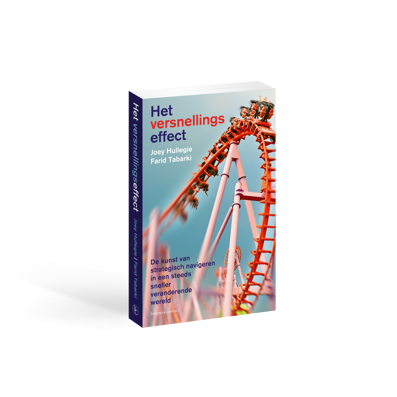 Het Versnellingseffect was published in November and mainly shows how fundamental organising forces such as authority, place, value and the human dimension are under pressure. Together with co-author Joey Hullegie, Farid Tabarki describes the new rules of the game that organisations need to keep a grip on a world in which everything is accelerating.
So the acceleration effect also applies to insurers?
"That applies precisely to insurers. In the book The Acceleration Effect, which I wrote together with Joey Hullegie, we analyse how acceleration and uncertainty fundamentally change the playing field of organisations. And why agility, trust and continuous development become crucial. For example, it can be a matter of lifelong development or a relationship of trust. It is clear that the relationship between the insured and the insurer is changing. We have traditionally been used to being in a relationship for longer periods of time. This can remain the case, but more often something will be temporarily stopped or a service will have to be added. The most important thing is that insurers must become better at maintaining that relationship. Developments follow each other faster and faster. This makes people anxious. They find it exciting what is happening and are looking for grip and security. Insurers can play a unique role in this by reassuring people and offering security."
Yet you write in The Acceleration Effect that the anchors of our known world are dying. Everything that offers certainty disappears. Isn't that bad news for insurers?
"If an insurer does not move along, yes. Then it looks bad. But on the other hand, it is mainly a matter of listening carefully to your customers. What do they need? It is precisely because insurers have a relationship of trust with their customers that they have an advantage. Just look at the prevention side. How great would it be if insurers could soon play a crucial role in preventing accidents. This leads to more safety and a safer life. Doesn't seem like bad news to me. Right?"
Finally. You emphasise in the book that we are constantly on the move. Do you know where we are going?
"There is no final destination. We are on the road and will stay on the road. Permanently. And sometimes the weather is nice and then a bit worse. Nobody really knows what will happen tomorrow or the day after tomorrow with this rapid technological revolution. Above all, let's enjoy the trip and fill in the preconditions as well as possible. For insurers, it means that they must continue to renew, innovate and empower their employees as much as possible, so that it remains a pleasant ride for everyone."
(Text: Miranda de Groene - Image: Fjodor Buis)